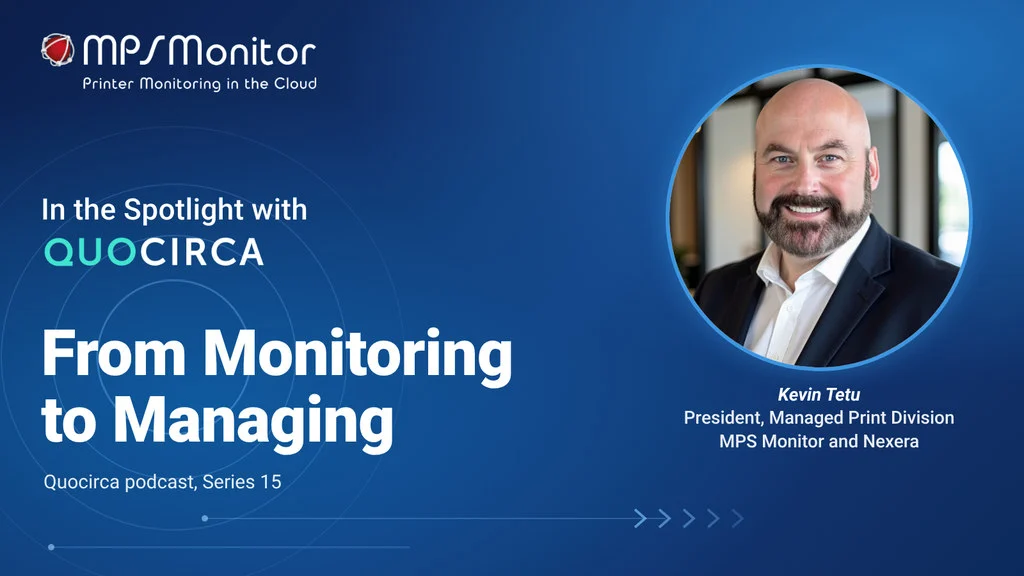
The MPS market is entering a new period of innovation. In a recent episode of the Quocirca podcast In the Spotlight, Louella Fernandes, CEO of Quocirca, asked Kevin Tetu, President of the Managed Print Division at MPS Monitor and Nexera, what is driving it and what dealers can do next.
Kevin describes the direction as a move from monitoring to managing. Here are the points of the conversation that matter most for dealers.
Why the market is moving
Kevin sees three changes arriving together. Dealers are modernizing their platforms and moving from legacy systems to a new generation. Customers expect proactive, transparent service. AI lets providers use operational data in ways that were out of reach before.
The change starts with end customers. They do not want to report each issue or wait for a problem to hit their productivity. They expect their dealer or provider to recognize potential issues and fix them before they disrupt work. Dealers hold similar expectations for their own operations: better visibility, fewer manual processes, clearer information on service performance and profitability, and systems that connect to their back-end tools.
For many years the industry focused on collecting data, and Kevin expects the future of managed print to depend on what dealers do with it. Dealers hold the raw material: more than 20 years of collected information. Kevin places the obstacle in how that information is organized:
“It’s definitely not the lack of data. It’s more about the fragmentation across the different systems […] The data is not always presented with enough context. […] A report can tell you what happened, but it doesn’t necessarily explain why it matters or what should happen next.”
Dealer teams end up moving between several systems and assembling the picture by hand. Kevin sees that time as the point where value gets lost.
From monitoring to managing
The gap between collected data and usable insight explains the shift Kevin describes. Monitoring identifies a condition or an opportunity. Managing adds the context, recommends the action and helps the dealer improve the outcome. It gives dealers an understanding of what is happening in the fleet, a view of what is likely to happen next and the ability to act on both.
The work starts with integrating the data, improving its quality and delivering it to the right people at the right time. That is when operational data becomes practical intelligence.
Kevin points to the combination of MPS Monitor and Nexera as one way to get there. MPS Monitor provides reliable visibility into devices and fleets. Nexera adds service performance data, benchmarking and operational expertise from decades in the industry. With both under one division, dealers see how their fleet runs and how their service organization performs, and they know which action to take. Kevin describes the strategy this way:
“It’s about creating practical connections between fleet visibility, service intelligence and business execution. That’s going to help the dealer in a number of areas. It’s going to improve technician performance, service quality and customer satisfaction and, ultimately, and this is what most dealers are worried about, their profitability”.
Where to start
The next question is where to begin. Louella asked Kevin what will set the most successful MPS providers apart and how dealers should prepare. Kevin expects the dealers that succeed to deliver manageable, measurable business outcomes, strengthen their customer relationships and improve operational efficiency. He sees a shared pattern:
“What we’re seeing across the industry, especially with the leaders, is that it’s really about connecting the technology foundation, having reliable data and having the organizational ability to actually act on the insights the systems provide.”
To see where their own business stands, dealers can examine three areas:
- Where does important information sit in isolation?
- Which tasks depend on manual processes?
- Where do customers face avoidable delays or inconsistencies?
Kevin describes these three areas as a place to begin. Next, he recommends investing in security, integration and data quality, since AI delivers its value when accurate information supports it and well-designed processes carry it. He also advises dealers to involve their people: technology helps employees make better decisions and deliver better service, and their experience remains central to the result. The combination that works, in his view, is strong technology, industry expertise and a willingness to adapt.
Listen to the full conversation
The episode goes further than this summary, with Kevin’s views on AI, security in hybrid environments and remote service. Listen to the full conversation on Quocirca’s YouTube channel: https://www.youtube.com/watch?v=OhgSRg92tmE
See Monitor → Manage in practice: request a free trial.
Source: Quocirca, In the Spotlight, Series 15 (13 October 2026). Quocirca is a trademark of its owner.